The analysis a deal pod runs — in one pass, with the sources attached.
Most tools give you an answer. AKAXA gives you an answer you can trace, approve, send, and still be holding two years later when the LP asks how you underwrote it.
A sourced number brings its filing with it.
Hover any source. It shows the document and the date the number was actually true — not “as of today,” but as of the filing it came from.
| Operating metric | Value | As-of | Source |
|---|---|---|---|
| Revenue YoY growth | 62.0% | FY2025 | SEC XBRLForm 10-K · FY2025 · XBRL-tagged revenue, verbatim tie-out. |
| Gross margin | 67.3% | 2025-12-31 | SEC XBRLForm 10-K · balance date 2025-12-31. |
| EBITDA (GAAP) | $78M | 2026-02-18 | SEC XBRL8-K exhibit · earnings release 2026-02-18. |
| Adjusted EBITDA | $248M | 2026-02-18 | Unverifiable: non-GAAPStatus is a source too. Company-defined adjustment, no verbatim tie-out — flagged, not trusted. |
A quote that doesn’t tie back to the source text as a substring is not softened, not paraphrased. It’s dropped.
The diligence a deal pod would actually run.
Each run covers what the material supports and names the rest. Not a summary — the workstreams.
Plus cross-axis synthesis, a de-duplicated red-flag roll-up, sector benchmark, diligence gaps, and multiple-compression risk.
The strongest case against your own deal.
Same evidence, skeptical priors. AKAXA argues the other side before the room does.
Files you can open, argue with, and defend.
Built from one evidence layer — so the three stay consistent. Every export is stamped “review copy — verify before reliance.”
Pre-IC diligence scan
Ten workstreams, red flags, valuation, Risk & SPA, 100-day plan, IC memo — and a named list of the gaps it couldn’t close.
The scan, editable
Mark it up and take it into the room. The sources travel with it.
IC deck
PowerPoint export is not available yet.
LBO workbook
Sources & Uses, sensitivities, scenarios — plus Input Gaps, Source Requests, and an Audit Trail sheet.
Four states. What can be sent depends on which one you’re in.
Sourced, no missing critical field. Full export.
Coverage is thin. Exports with source-gap footnotes.
Screening brief only. The IC memo is held back.
A critical validation failed. The file does not render.
Six seats around it.
Associate
Turns the raw data room into first-pass evidence — in one run.
VP
Pressure-tests the assumptions and organizes the workstreams.
Principal
Sharpens the thesis, the risks, and the open questions.
Partner
Reads one coherent memo and decides where to push.
Operating partner
Carries the underwriting thesis into value creation.
IR / LP
Receives an output that carries the sources behind its claims — and can’t be sent if they’re missing.
Controlled is the moat.
| Tool | What it gives you | What it can’t do |
|---|---|---|
| Generic AI chat | Fast answers | Can’t show where the number came from |
| Document search | Good retrieval | No accountability for the artifact |
| Research agent | Useful synthesis | Shallow on deal governance |
| AKAXA | Evidence, memo, and a gate | Holds back what it can’t stand behind |
Sixteen systems that don’t agree. Or one spine that can’t contradict itself.
The CRM says one revenue number, the model says another, the LP letter says a third. On AKAXA every workspace reads from the same evidence layer.
Every live deal on one board, with its score and decision state.
First-pass scoring on evidence, not on a deck’s own claims.
Ten workstreams; wall-crossing is a request, an approval, and a record.
One memo, sourced claims tied out; work that fails the gate can’t export.
The 100-day plan the scan produced becomes the plan you run.
Every holding: tearsheet, financials, covenants, value-creation.
LP letters from the same record the deal was underwritten on.
The deal closes; its record doesn’t. It feeds firm memory.
Live surfaces, in-build surfaces — labelled, not hidden.
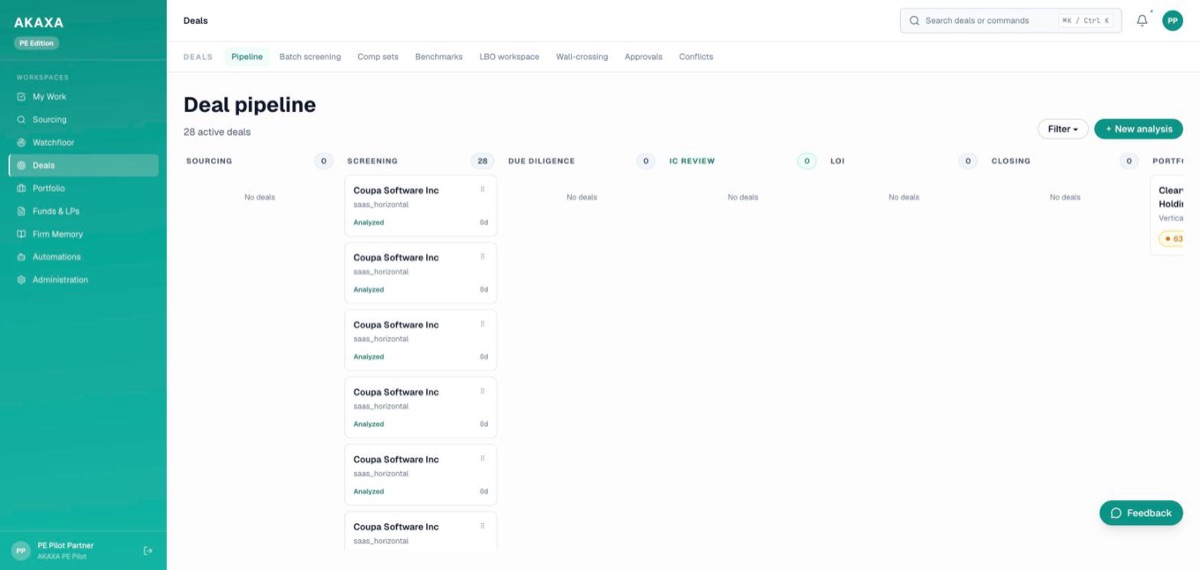
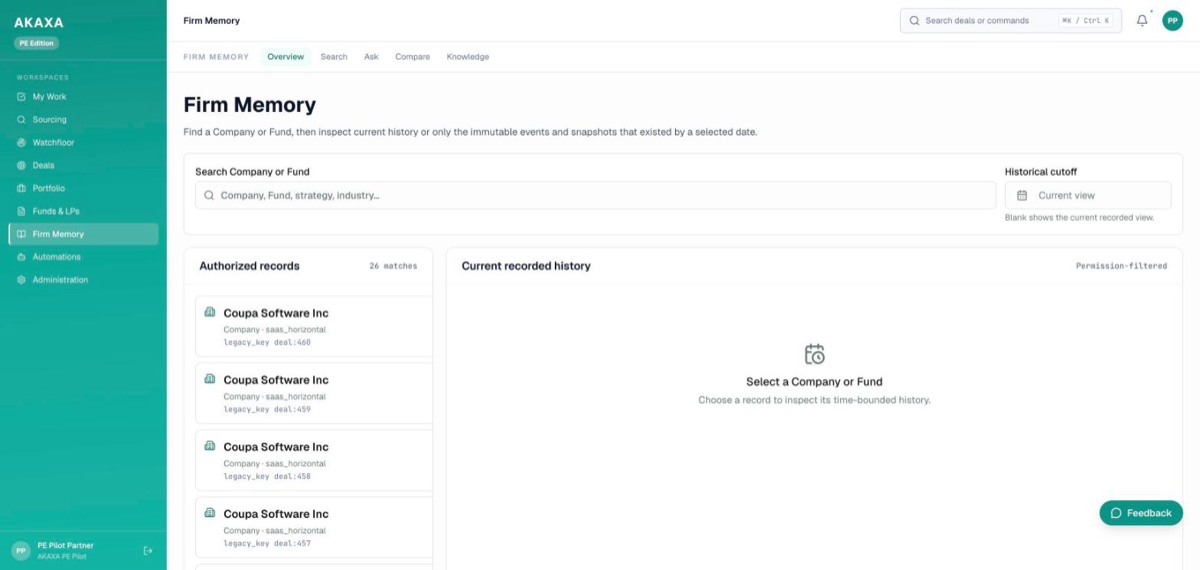
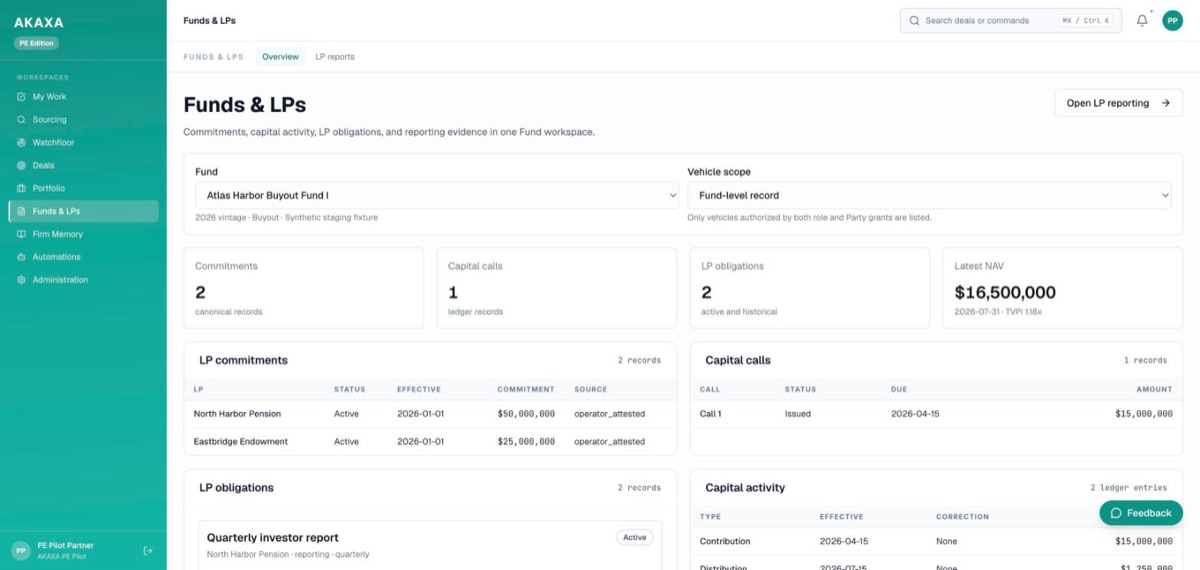
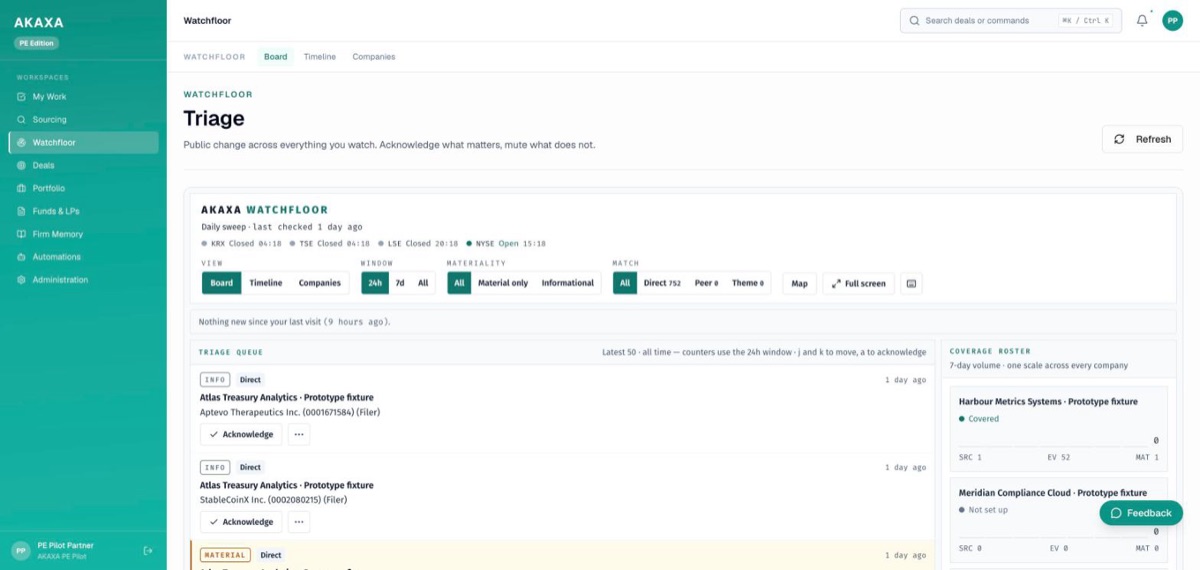
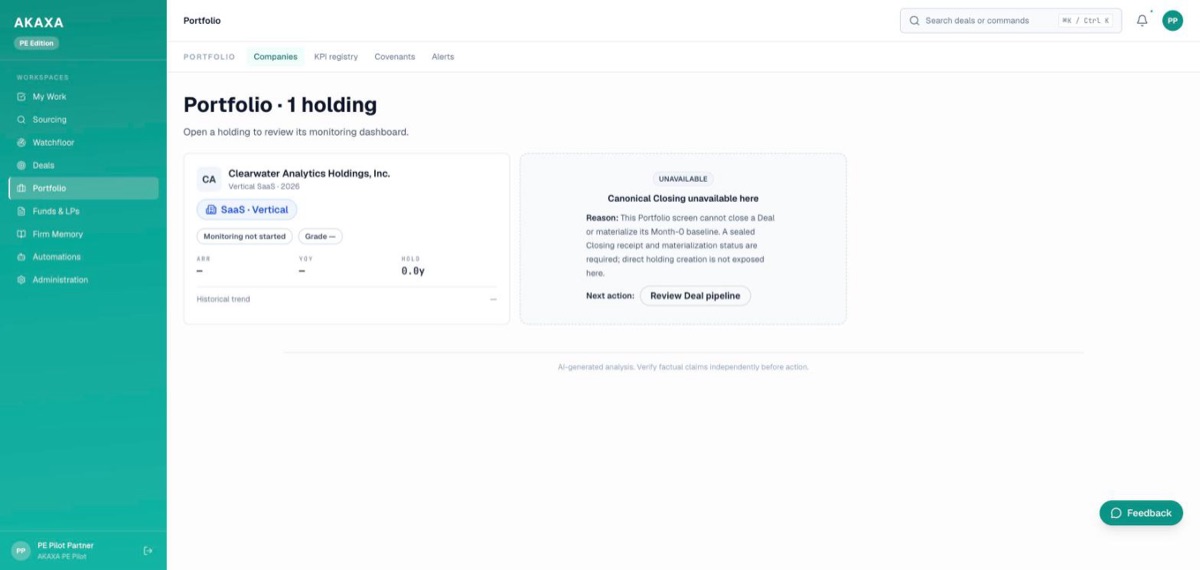
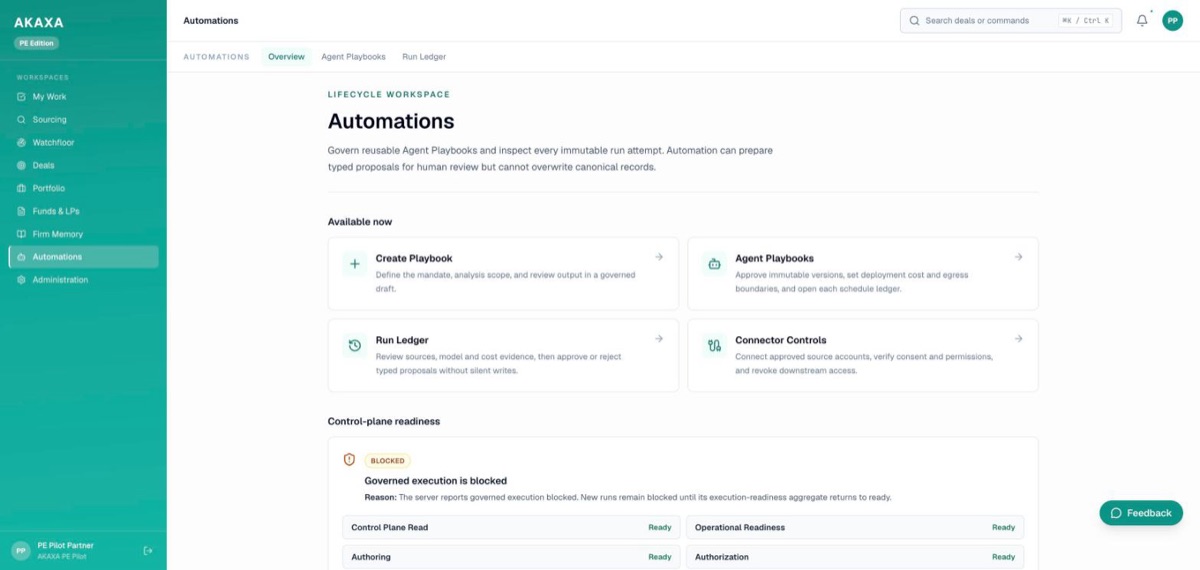
Shown on synthetic pilot data. Each surface states its own status inside the product — available now, not available here yet, or blocked.